Helix v2Enterprise software that adapts to the business.
A configurable operations platform where definitions control fields, forms, and workflows, with version history and review for changes.
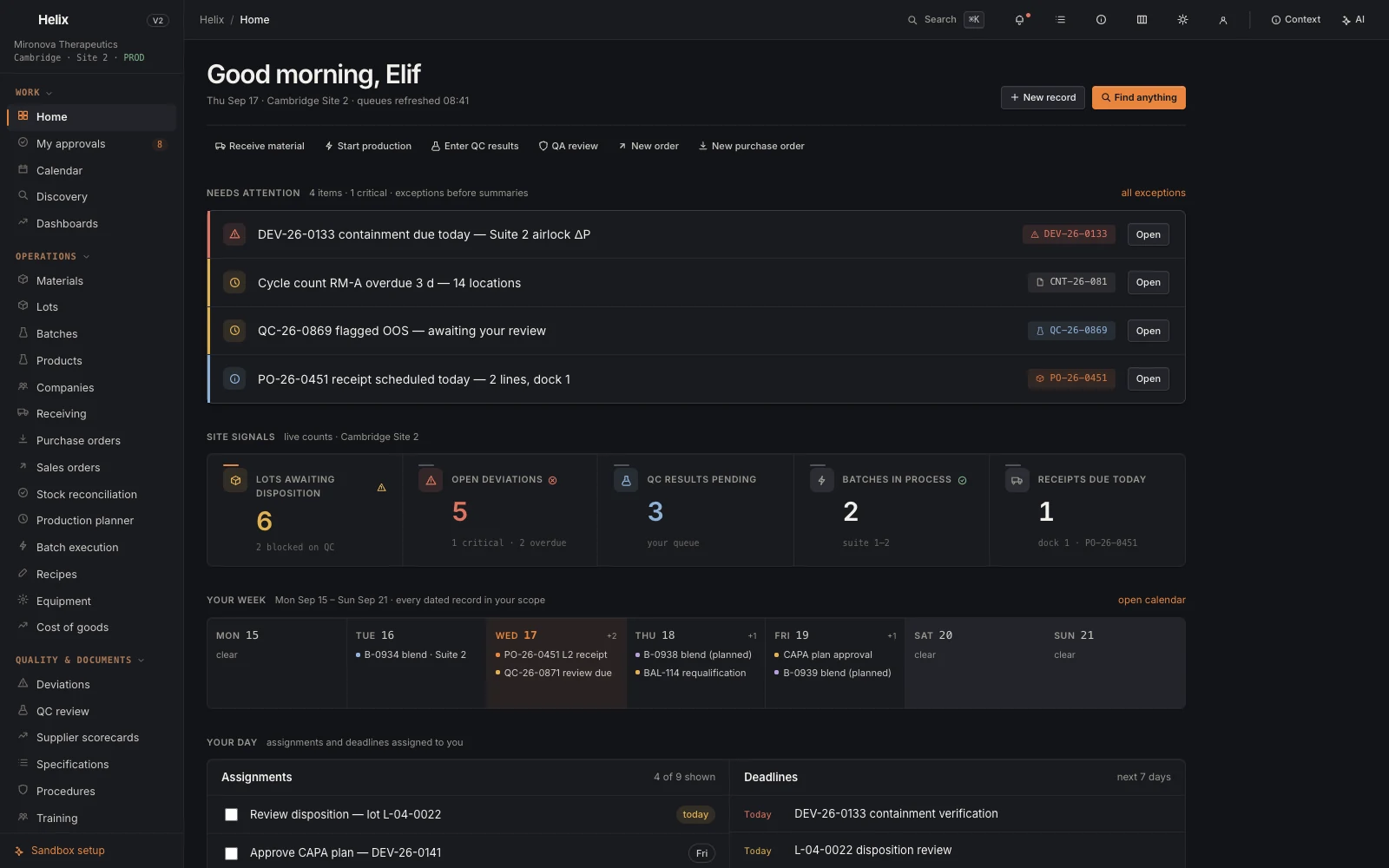
Screenshot of the original Helix v2.1 design prototype. All names and operational records are sample data.
What Helix v2 does.
Helix v2 addresses a familiar enterprise problem: every team has its own records, rules, approvals, and exceptions. Adding each variation as custom code becomes expensive.
The platform describes those variations as definitions. A definition specifies fields, relationships, validation, interface settings, and supported behavior; reusable engines interpret it.
The difficult part is changing the system without changing what an old record means. Versioned definitions and controlled publication are central to the design.
The problem
Teams need to customize workflows without a new module for every change. Those changes also need to preserve historical records, permissions, and approvals.
Add a field and review the change
Edit a sample definition, review the proposal, and activate a new version. This simplified model uses sample records and does not connect to a Helix organization.
Read the demonstration walkthrough
- Store immutable definition versions in the database and load them into a runtime snapshot.
- Combine vendor definitions, installed domain packs, and organization-specific configuration.
- Use shared engines to read, write, validate, and move records through workflows.
- Review definition changes with diffs, validation, approvals tied to a content hash, and retained history.
How it works.
Store immutable definition versions in the database and load them into a runtime snapshot.
Combine vendor definitions, installed domain packs, and organization-specific configuration.
Use shared engines to read, write, validate, and move records through workflows.
Review definition changes with diffs, validation, approvals tied to a content hash, and retained history.
Definition language
Zod contracts specify the supported fields, conditions, procedure inputs, and interface metadata. Changes to the language itself require an engine version.
Shared engines
Framework-neutral engines interpret definitions through storage, audit, signature, workflow, and integration interfaces.
Versioned runtime
Fastify and tRPC host the platform. MongoDB stores definition versions. Historical resolution uses retained exact references, including their composition, rather than the latest runtime snapshot.
Forms and workspace
React, Radix, and Tailwind render definition-driven forms and operational views. Registered native capabilities handle behavior the definition language cannot express.
Why it’s built this way.
Keep executable behavior in the engine
Definitions use a supported language that the engine validates and interprets. Native behavior needs a registered capability; arbitrary code cannot be hidden in a field setting.
Use the same review process for every change
Typed source files remain useful for authoring vendor definitions. Their synchronization tool calls the same validation, approval, and audit services as the runtime editor.
Keep old records readable
Records carry definition-version stamps and retained references. Historical reads and release qualification still have unfinished work in the current development version.
What to keep in mind.
- 01Configuration authors need useful diffs, validation messages, and a clear view of what a change affects.
- 02Customization needs explicit limits on what can be changed and who can activate it.
- 03Plan for historical reads when designing versioned schemas.
V2 is in development. Foundation testing and release qualification remain unfinished.
Technical details come from the project’s source code and documentation. The demo uses sample data.